After a very long summer of no posting I am happy to say that I have managed to co-ordinate the camera and the cooking process... at least enough to document something I haven't made for a long time but always remembered fondly... fondly enough to want to do it again.
In the UK I made this with foraged crab apples and home grown chillies. It became a family favourite and cheese was never quite the same without it. Here in Spain cheese is served with membrillo (a kind of quince cheese) and it is delicious, especially if home made, but I really hankered after my old favourite so....
Firstly, I forgot which recipe I used. So I found one in this book.....
... Which I thought was probably the one, it had some pencil notes about doubling quantities and cooking times for larger batches, so I guessed it was likely the one.
Ingredients:
1kg tart apples - I used Granny Smiths.
1.5 litres water
50ml cider vinegar
2 cinnamon sticks
1 and 1/2 cups granulated sugar
2 Cinnamon sticks
1/2 teaspoon whole cloves
4 whole red chillies (this is an extra that I add to give it a bit of a kick)
(I apologise for the measurement of sugar being in volume rather than weight - I hate using volume, I find it is so inaccurate, but that is how the recipes are in this particular book - being aimed at the American market)
Method:
Put the apples, water, vinegar, cloves, cinnamon and chopped chillies (I included the seeds but its up to you if you do or not) into a large pan, cover and bring to the boil, reduce the heat to a gentle simmer and cook until the fruit is very soft - soft enough to push through a sieve.
When cooked, strain it through a sieve first to remove the solids and then through a jelly bag to extract the juice. Return this juice to the now cleaned pan and add the sugar.
Bring to the boil and boil rapidly until setting temperature is reached and then continue to boil until you achieve a 'gel'.
A jam thermometer is indispensable to ensure that you get a good set on the jelly.
To check that it is set I usually put a saucer into the freezer until its very cold and then put a teaspoonful of hot jam onto the saucer, replace in the freezer for a minute or two and then check it to see if it crinkles when disturbed by your finger. As soon as it does, its ready to pot. Sterilise your pots in boiling water and drain and dry in a warm oven. Pour in the hot jelly and pop on the lid....
I know the book is called Small Batch Preserving but this really is a very small batch. I think I boiled it a little longer than necessary but even so it still wouldn't have made much more than one pot, now I see why I marked on the page that I should double the quantity....
and then.... I found a piece of paper stuffed into the back of another preserving book with my favourite recipe - which is basically the same but the quantities are much larger and it also suggests that you make Apple chilli butter with the pulp - I had already put mine on the compost, but perhaps next time. It was delicious and the little pot has already been used up with cheese for afternoon snack!
Here you will find all things relating to the food we produce on the farm, as well as what is in season generally in Spain. Recipes, hints, tips and advice for the keen ex-pat cook in Spain.
Showing posts with label September. Show all posts
Tuesday, 8 September 2015
Saturday, 20 September 2014
Autumnal Fare
Summer was hot and felt like it went on for ever but in reality it passed rather quickly... two months and five novels later and autumn arrived all of a sudden with gifts of grapes and experiments in preserving.
Our own grapes (all five of them) were snaffled by one of the hens that snuck into the veggie plot but gifts from friends who have plenty meant that we had to find a use for them. The first thought with grapes is always wine but here where the wine is so cheap and usually so good we decided against it.
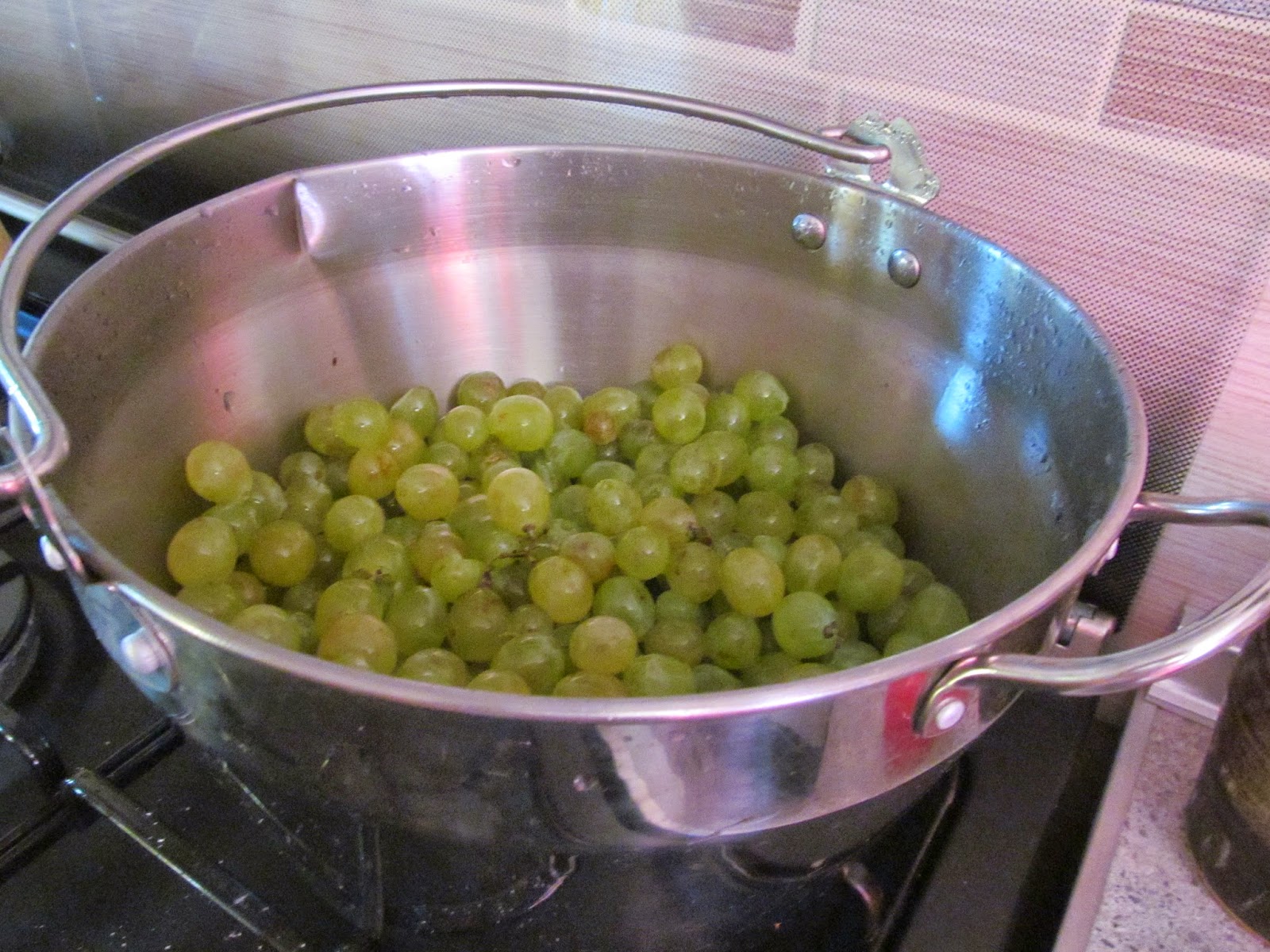
We made juice first off. Wash the grapes and then heat them gently in a large pan with a cup of water until they are almost boiling. You can squeeze them now if you want, if you do the resulting juice is cloudy, if you don't it will stay clear but of course you will have less of it.
If you taste it and it is tart then you can add some sugar and stir while it is warm to dissolve it. We didn't need to. One bottle of juice doesn't seem very much but we diluted it with tonic water to make a very grown up and refreshing non alcoholic drink. We did a similar thing with a glut of plums (again gifts from friends), extracting the juice and then boiling it with almost equal quantities of sugar to make a syrup. The syrup was then used as a cordial with water or lemonade and even added to champagne for a fruity celebratory touch.
The rest of the grape juice I had left was destined for an experiment. I wanted to make grape jelly. A jelly is like a jam but usually clear and without lumps of fruit in it. Grapes have no natural pectin so I needed to add pectin to it. A while ago I purchased some powdered pectin (you buy it at the chemist here) specifically for making herb jellies. Alas it came without any instructions or quantity to use information so I have hung on to it for ages dithering about using it. An internet search is of no help here since all the pectin seems to be preparatory brands and comes with its own instructions.
So.... I mixed 7 tablespoons of powdered pectin with the sugar and added it to the juice and brought it to the boil. When it reached setting point I jarred it up and crossed my fingers. The result? It didn't set. Its thick but still more a syrup than a jelly. Never mind, its great on rice pudding and will spread on toast and we have even added it to gravy for the Sunday roast.
Other experiments were with drying. We dried some tomatoes with great success. I put some in oil, and I kept some in an airtight container only to find moths in with them a couple of weeks later... oooh er. I understand the knack is to freeze for three days after drying in order to kill anything off... but I would prefer to ensure that nothing is in there in the first place. The tomatoes were dried under nets and brought in overnight but still those pesky moths managed to find a way to them. More effort required there I think.
Long term I think a drying box or cupboard has to be the way to go.
And then..... we were introduced to people who have their own olive press. And given some of their last years batch of oil. Mmmmmmm.... maybe next year if we can afford it, trouble is, it isn't simply a case of buying the olive press... we need to build a room or shed to put the press in... could end up as a very expensive project.
Our own grapes (all five of them) were snaffled by one of the hens that snuck into the veggie plot but gifts from friends who have plenty meant that we had to find a use for them. The first thought with grapes is always wine but here where the wine is so cheap and usually so good we decided against it.
We made juice first off. Wash the grapes and then heat them gently in a large pan with a cup of water until they are almost boiling. You can squeeze them now if you want, if you do the resulting juice is cloudy, if you don't it will stay clear but of course you will have less of it.
If you taste it and it is tart then you can add some sugar and stir while it is warm to dissolve it. We didn't need to. One bottle of juice doesn't seem very much but we diluted it with tonic water to make a very grown up and refreshing non alcoholic drink. We did a similar thing with a glut of plums (again gifts from friends), extracting the juice and then boiling it with almost equal quantities of sugar to make a syrup. The syrup was then used as a cordial with water or lemonade and even added to champagne for a fruity celebratory touch.
The rest of the grape juice I had left was destined for an experiment. I wanted to make grape jelly. A jelly is like a jam but usually clear and without lumps of fruit in it. Grapes have no natural pectin so I needed to add pectin to it. A while ago I purchased some powdered pectin (you buy it at the chemist here) specifically for making herb jellies. Alas it came without any instructions or quantity to use information so I have hung on to it for ages dithering about using it. An internet search is of no help here since all the pectin seems to be preparatory brands and comes with its own instructions.
So.... I mixed 7 tablespoons of powdered pectin with the sugar and added it to the juice and brought it to the boil. When it reached setting point I jarred it up and crossed my fingers. The result? It didn't set. Its thick but still more a syrup than a jelly. Never mind, its great on rice pudding and will spread on toast and we have even added it to gravy for the Sunday roast.
Other experiments were with drying. We dried some tomatoes with great success. I put some in oil, and I kept some in an airtight container only to find moths in with them a couple of weeks later... oooh er. I understand the knack is to freeze for three days after drying in order to kill anything off... but I would prefer to ensure that nothing is in there in the first place. The tomatoes were dried under nets and brought in overnight but still those pesky moths managed to find a way to them. More effort required there I think.
| grapes in a net bag ready for drying |
I kept back some grapes for drying to make raisons. They have seeds in them which I hate but I might just spend an evening removing the seeds individually before using them for a Christmas pudding or some such. This isn't something I plan to do a lot of in future. At the moment the grapes don't look very appetising. The recent spate of rains has not helped the drying much either.
| experiment in drying grapes hanging up |
| grapes drying on a clothes horse |
And then..... we were introduced to people who have their own olive press. And given some of their last years batch of oil. Mmmmmmm.... maybe next year if we can afford it, trouble is, it isn't simply a case of buying the olive press... we need to build a room or shed to put the press in... could end up as a very expensive project.
Subscribe to:
Posts (Atom)